

The short answer
AI for flooring stores works best on repetitive, rules-based work around the sale: answering enquiries after hours, turning measurements into draft quotes, following up open quotes, chasing overdue invoices, matching payments and summarising the day. The selling itself stays human. Only about 14 percent of US retailers use AI so far, so stores that start now gain an edge while keeping staff approval on anything customer-facing.
At this year’s flooring conventions, the conversation about AI changed tone. Dealers who were sceptical a year ago are now asking practical questions: what can it actually do in my store, what does it cost, and will customers notice? FCNews reported dealers at the Alliance Flooring convention describing exactly that shift, from wariness to seeing it make their day easier.
This guide to AI for flooring stores skips the hype. It covers eight ways flooring stores are using AI right now, what each one is worth, and the parts of the business you should keep firmly human.
Is AI actually useful for a flooring store?
Yes, for a specific kind of work. AI is good at tasks that are repetitive, text heavy and follow a pattern: reading a message and pulling out the measurements, drafting a polite reminder, matching a payment reference to an invoice, summarising what happened today. It is not good at judging whether a subfloor needs levelling or reading the mood of a couple choosing between oak and hybrid.
That split maps neatly onto a flooring store. Around every sale is a layer of admin that slows the team down. AI handles that layer so people can do the parts customers actually value.
The opportunity is the gap. Larger firms are adopting fastest, while small retailers lag. For an independent flooring store, using AI well is still a differentiator rather than table stakes.
8 practical uses of AI for flooring stores
How AI works safely in a flooring store
The AI does the preparation. People stay in charge of anything a customer sees.
The approval model used at Choices Flooring Mackay.
1. Answering enquiries the moment they arrive
Web forms, Facebook messages and missed calls at 7pm all deserve a reply before the homeowner moves on to the next store. An AI assistant can reply instantly, answer basic questions about products, availability and the measure process, and offer measure times. Your salesperson takes over in the morning with the full conversation. See our page on AI receptionists for flooring.
2. Turning measurements into draft quotes
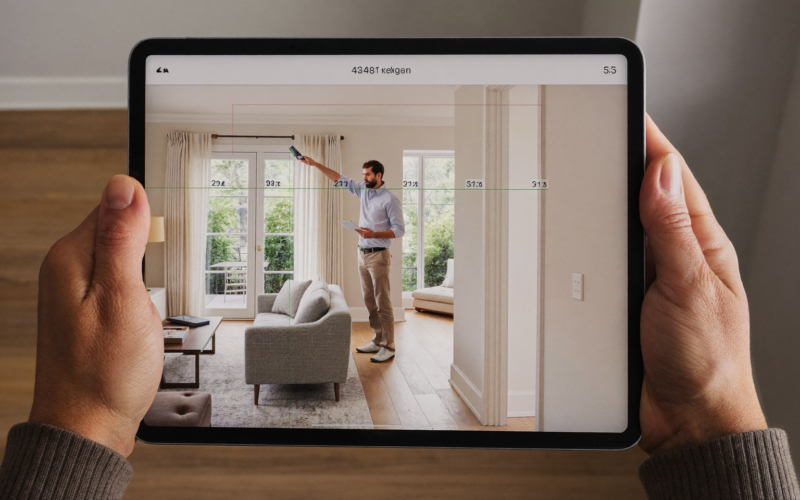
This is where the time savings are largest. Instead of 15 to 20 minutes per quote, a salesperson sends the room measurements and product choice in one message. AI calculates quantities with waste, adds underlay, removal and labour from your price list, and returns a draft for approval. At one Choices Flooring store in Mackay, this cut quoting to under a minute.
3. Following up every open quote
Most stores follow up a fraction of their quotes. AI can run a personalised follow-up sequence on every one, referencing the rooms and product, and pause the moment the customer replies. The Mackay store went from about 30 percent of quotes followed up to 100 percent.
4. Chasing overdue invoices politely
Reminders on a fixed schedule, worded to protect the relationship, with escalation to a person only when needed. Our guide to getting paid faster covers the cadence.
5. Matching payments to invoices
Customers pay deposits and balances with references like “floor” or just their surname. AI can match the obvious ones instantly and send the ambiguous ones to a person with a suggested match. Reconciliation that took two hours a day can drop to minutes.
6. Entering customer details once
AI can read an enquiry, email or measure sheet and create the customer record in your CRM and accounting tools, instead of someone retyping it in three places.
7. Preparing salespeople for the conversation
Hardwood Floors Magazine highlights a different use: helping salespeople prepare for common objections on price and durability, and guiding customers through choices without overwhelming them. AI can produce a one-page brief before a showroom appointment with the customer’s history and likely questions.
8. A daily summary for the owner
Rather than checking five screens, the owner gets one message each morning: quotes waiting for approval, jobs at risk, payments received, installers booked. Owners at the Mackay store saved more than three hours a day on these checks.
| Use | Best for | Keep human |
|---|---|---|
| Enquiry replies | After-hours and busy periods | Complex or upset customers |
| Draft quotes | Standard residential jobs | Final price and approval |
| Quote follow-up | Every open quote | Day 7 phone call |
| Invoice reminders | Polite scheduled nudges | Disputes and hardship |
| Payment matching | Clear references | Conflicts and partial payments |
| Customer onboarding | Data entry | Checking unusual jobs |
| Sales prep | Showroom appointments | The conversation itself |
| Daily summary | Owner visibility | Decisions |
What AI should not do in a flooring store
- Send prices without approval. A draft quote should always be checked by someone who knows the job.
- Diagnose installation problems. Moisture, subfloor and warranty questions need an experienced person.
- Pretend to be human. Customers accept a quick automated reply when it is honest and helpful. They resent being misled.
- Handle complaints alone. An unhappy customer should reach a person fast.
The human-in-the-loop rule: let AI prepare, and let people approve. At the Mackay store, staff approve sensitive actions such as quotes and payment conflicts over WhatsApp in a tap, which kept the team confident from week one.

What changed at a Choices Flooring store in Mackay
One independent store in the Choices Flooring network, Mackay, Queensland. Ava, a Veloq digital employee, works inside the store’s existing CRM and staff approve anything sensitive over WhatsApp.
Figures from Veloq’s case study with Choices Flooring Mackay. Results from one store; yours will depend on volume and process.
None of these results came from replacing people. They came from removing the admin between people and customers. That is the right lens for any AI decision in a flooring business: does it give your team more time with customers?
How to start with AI in your flooring store
- Write down your top three time sinksAsk your team which tasks they would happily never do again. Quoting, chasing and data entry usually top the list.
- Choose one with a clear before numberPick a task you can measure, such as minutes per quote or percentage of quotes followed up.
- Run it inside your existing toolsAI should work with your CRM and flooring software, not replace them. Avoid anything that requires a big migration to start.
- Keep approvals with staff for the first monthReview what the AI prepares. Loosen control only where it has been reliably right.
- Measure, then add the next workflowCompare against your before number after two to four weeks, then move on.
Not sure where AI fits in your store? We will map it with you in 30 minutes.
Book a free call →AI for flooring stores: FAQs
How are flooring stores using AI?
The most common uses are instant replies to enquiries, turning measurements into draft quotes, following up open quotes, chasing overdue invoices, matching payments and producing daily summaries for owners.
Will AI replace flooring salespeople?
No. AI handles admin around the sale. The selling, product advice and relationship stay with people, and stores that use AI well give salespeople more time with customers.
Is AI expensive for a small flooring store?
It does not have to be. Starting with one workflow, such as quote follow-up, keeps cost low and usually pays back through recovered jobs within weeks.
Do customers mind talking to AI?
Most customers care about a fast, accurate reply. Be honest that a reply is automated, keep it helpful, and make it easy to reach a person.
Does AI work with RFMS, QFloors or Floorzap?
AI tools can usually connect to flooring software through APIs, integrations or the CRM you already use, so you keep your existing system.
Related guides
- Flooring business automation: what to automate first
- How to quote flooring jobs faster
- Missed calls are costing your flooring store jobs
- What a flooring CRM should actually do
Sources
- US Census Bureau, Large firms with at least 20 employees biggest AI users (May 2026)
- FCNews, Flooring dealers embrace AI, slowly but surely (May 2026)
- Hardwood Floors Magazine, Leveraging AI to win more flooring sales (April 2026)

Meesam builds AI automations for flooring stores and contractors at Veloq, the engineer-led AI software house. He works hands-on with flooring businesses like Choices Flooring in Mackay, Queensland, automating quoting, lead follow-up, debtor chasing and payment matching inside the tools they already use. His guides draw on that client work and on current flooring industry research.